
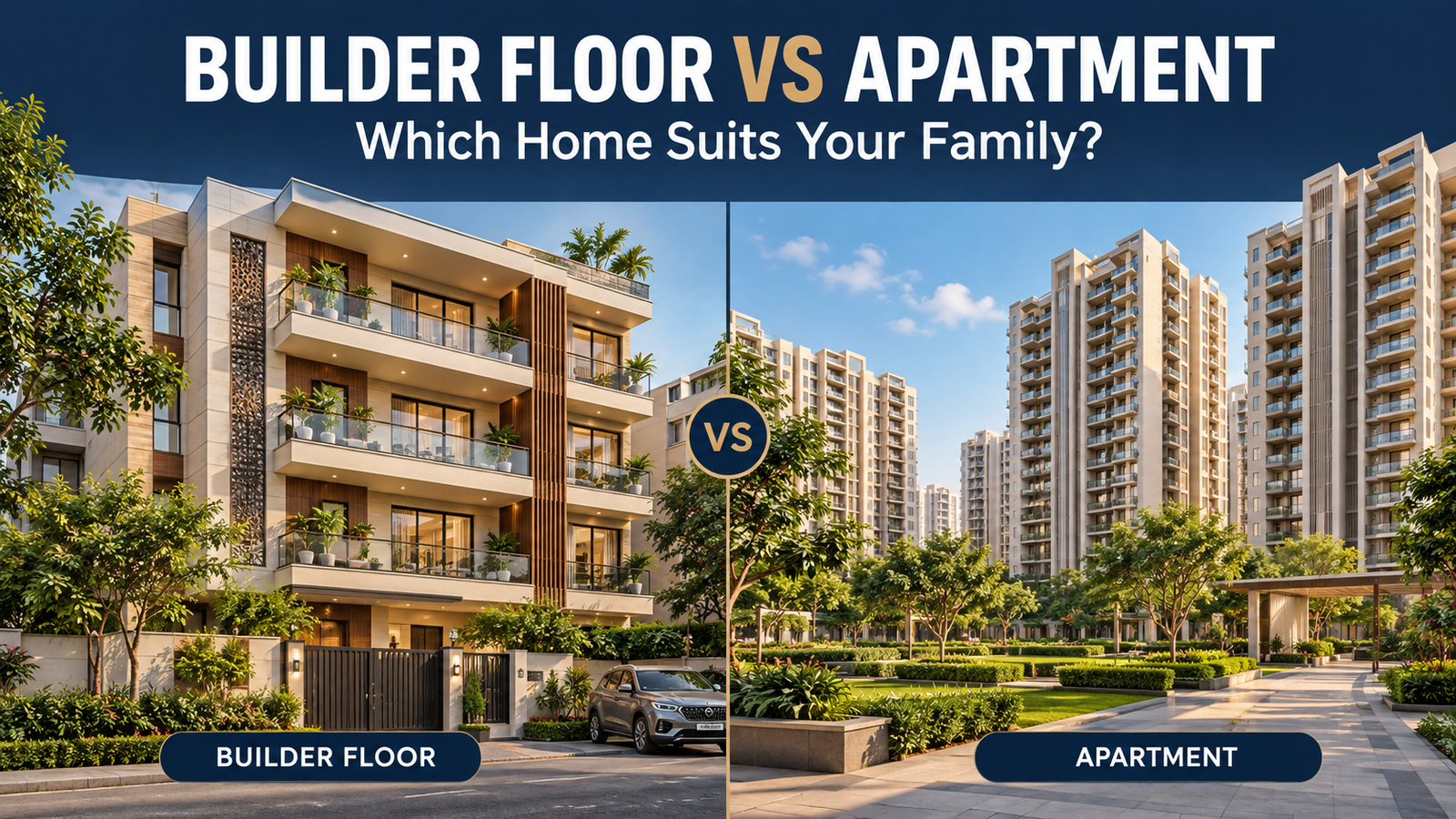
A home can look perfect in photographs and still feel wrong for your daily routine. Perhaps the living room is spacious, but the school run is difficult. Or the society has a swimming pool, but the bedrooms leave little space once you move in your furniture.
That is why the builder floor vs apartment decision deserves more than a comparison of prices and amenities.
For families looking for a home in Chhatarpur, South Delhi or elsewhere in Delhi NCR, the useful question is: how will this property work on an ordinary weekday? Think about privacy, children, elderly parents, parking and who takes care of the building when something needs fixing.
What Is the Difference Between a Builder Floor and an Apartment?
A builder floor generally refers to a self-contained home in a smaller, low-rise building, often with one residence occupying a floor. A home in a larger apartment complex is usually one of several units, with shared entrances and facilities.
Here, “apartment” means a home in a larger residential building or society. The terms can overlap in property listings, so always check the actual layout and ownership documents.
A builder floor may still share a staircase, lift, driveway or water tank with other residents. Apartments also vary: some are in small buildings, while others belong to large communities with extensive facilities.
Builder Floor vs Apartment: A Quick Comparison
| What to compare | Builder floor | Apartment in a larger complex |
|---|---|---|
| Building layout | Often a smaller building with fewer homes | Often more homes across one or several buildings |
| Privacy | Fewer immediate neighbours can be an advantage | Depends on corridor layout, density and sound insulation |
| Facilities | Check what the specific project provides | Check which shared amenities are operational and included |
| Maintenance | Residents may coordinate shared repairs | Often organised through an association or manager |
| Parking | Verify the space and access in writing | Verify allocation, visitor parking and access in writing |
| Usable space | Compare carpet area and room dimensions | Compare carpet area and room dimensions |
These are starting points for a site visit, rather than promises about every property.
1. Privacy: Look Beyond the Number of Neighbours
If you work from home, host relatives regularly or prefer a quieter setting, fewer homes in the building may appeal to you.
But a builder floor is not automatically peaceful. A busy road outside the bedroom, an adjoining building or poor sound insulation can matter more than how many families share the staircase.
An apartment can also provide a comfortable, private home when entrances are thoughtfully positioned and the unit is away from noisy common areas.
During the visit, pause and listen. Check the bedrooms with the windows open and closed. Look at whether neighbouring balconies face your living room. Visit again in the evening if possible.
2. Space: Compare the Rooms You Will Actually Use
Two properties advertised as 3 BHK homes can have very different layouts.
One may have a large living room but limited storage. Another may offer a practical kitchen and better-sized bedrooms. A long passage can make a home look larger on paper without giving your family much extra usable room.
Ask for the carpet area and a dimensioned floor plan. RERA’s carpet-area measure includes internal partitions but excludes external walls, service shafts and exclusive balconies or open terraces. Plot size, built-up area and carpet area should not be treated as interchangeable figures.
Then imagine your own furniture in the space:
- Can the bedroom accommodate a bed, wardrobe and comfortable walking space?
- Is there room for a dining table without blocking movement?
- Where will a child study or an adult work?
- Is there storage for everyday household items?
A useful layout often matters more than an impressive headline area.
3. Children, Elderly Parents and Everyday Convenience
Families with children may value a place to play, nearby friends and a comfortable route to school. A society with an operational play area could suit that routine. A builder floor near a suitable park or close to grandparents might work just as well.
For elderly parents, examine the entire journey from the car to the living room. A lift is useful only if it is accessible, maintained and available when needed.
Check entrance steps, lift access, corridor lighting and how the lift operates during a power cut. Think about carrying groceries, using a stroller or helping someone who finds stairs difficult.
Also check the routes to schools, shops and healthcare facilities. Try the commute at the time your family would normally travel, rather than relying only on a map distance.
4. Maintenance: Who Handles a Problem?
The real test of a building’s maintenance arrangement comes when a water pump stops working or the lift needs repair.
In a smaller building, residents may need to agree on the contractor, payment and timing themselves. In a larger society, there may be an association or management team to coordinate the work. Confirm how the specific property is managed.
Ask who handles common-area cleaning, lift servicing, water systems and building repairs. Request the current charges and find out whether major repairs are collected separately.
A low monthly charge is useful only when essential work still gets done. Look at the service provided and the likely shared expenses, rather than comparing the monthly figure alone.
5. Amenities, Security and Parking: Check the Details
A pool or clubhouse adds value to daily life only if your family can use it, wants to use it and understands the associated charges.
Likewise, do not assume that a builder floor has no shared amenities. Some independent-floor developments sit within larger townships with recreational facilities. Availability depends on the project and the terms of access.
For either property type, check:
- How visitors and delivery staff enter the building.
- Who monitors access and whom residents contact after hours.
- Whether advertised facilities are operational or planned.
- Whether your parking space is clearly identified.
- Whether the car can enter, turn and leave comfortably.
If the household has two cars, confirm the arrangement for both. A parking label on a brochure does not explain how the space will work on a busy evening.
6. Ownership and Shared Areas Need Clear Answers
Privacy and ownership are separate questions.
Do not assume that buying a builder floor gives you exclusive rights over the entire plot or terrace. Equally, do not assume that an apartment buyer has no rights in shared property. Delhi’s apartment-ownership framework recognises individual apartment ownership alongside interests in common areas, where the Act applies.
Have a property lawyer review the title, sale documents and relevant approvals. Ask them to clarify any land share, terrace rights, parking arrangement and responsibility for common facilities.
Written clarity is especially useful when several households share a building. A verbal understanding may become harder to resolve after people move in.
Which Home Suits Your Family Better?
A builder floor may fit a family that values fewer immediate neighbours, likes the particular layout and is comfortable coordinating shared building responsibilities.
An apartment may fit a family that will regularly use the society’s facilities and prefers an established arrangement for common services.
Neither choice solves every problem. A well-planned apartment may offer more useful space than a poorly designed builder floor. A well-managed builder-floor building may be easier to live in than a society with unresolved maintenance issues.
Before deciding, list your family’s three non-negotiables. They might be reliable lift access, a manageable school commute and enough space for a work desk. Use that same list at every site visit.
A Simple Checklist Before You Shortlist a Home
For both builder floors and apartments:
- Walk through the rooms with the family members who will live there.
- Check daylight, ventilation, plumbing and visible signs of dampness.
- Test parking access and examine shared entrances.
- Ask for maintenance charges and the process for reporting problems.
- Review the price breakdown, possession terms and included specifications.
- Arrange professional checks of documents, approvals and construction where needed.
If the seller permits it, speak with existing residents about everyday services. Their experience can help you frame better questions.
Frequently Asked Questions
Is a builder floor the same as an independent house?
Usually, no. A builder floor is a separate home within a building that may contain other residences. It can share access routes or facilities, so check the specific arrangement.
Are builder floors cheaper than apartments?
There is no reliable rule. Compare actual properties in similar locations, with similar usable space, condition and facilities. Include the stated charges and foreseeable upkeep costs.
Do builder floors have lifts and covered parking?
Some do, but these facilities are property-specific. Inspect them and confirm the arrangement in the relevant documents before making a decision.
Which option is better for a family with elderly parents?
Focus on accessible entrances, reliable lift service, comfortable movement inside the home and convenient daily routes. Either type can work when the individual property meets those needs.
Explore a Home That Fits Your Routine
If you are considering builder floors in Chhatarpur, explore available homes with Oculis Developers and arrange a site visit.
Bring your priorities, ask to see the actual layout and discuss the documents and service arrangements. The visit should help you picture ordinary life in the home, as well as appreciate how it looks.